Flexible CIGS solar cells - Production
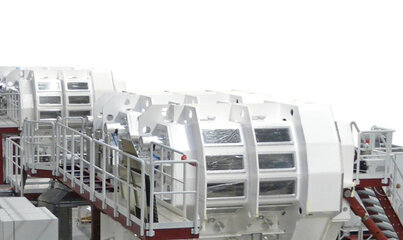
Roll-to-roll production system for the deposition of CIGS solar cells on films
Application
Solar energy is not only free, but - with time restrictions - also available everywhere. Where prolonged disconnection from the power grid is unavoidable, solar cells are cheaper and lighter than carrying energy in the form of batteries or fuel, e.g. for stationary systems in remote locations, in mobile outdoor applications or in satellites. For installation on roofs that do not have the statics for heavy panels or even tarpaulins, the solar cell must also be very light.
Requirements for the system
A line of roll-to-roll systems is to coat film with solar cells. The films are up to 1.6 m wide and up to 3 km long and require a metallic back electrode, a CIGS absorber layer and a transparent front electrode. While the electrodes are sputtered, the absorber layer must be produced by evaporation. The film must be heated to well over 200 °C in some cases to ensure good layer growth.
- High efficiency of the solar cell
- Low weight
- Cost-effective due to efficient mass production
Solution to the requirements
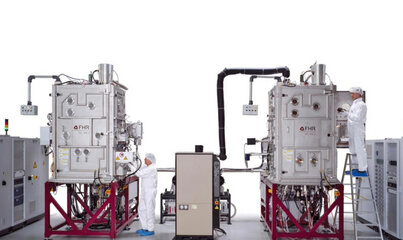
The line consists of four roll-to-roll systems, with the two sputtering systems (front and rear contact) and the two evaporator systems (absorber layer) each having a similar design. In all systems, the complete winding unit is extended on a large flange for good accessibility when inserting the strip. However, the technological units - sputter sources and evaporators - remain in the chamber. The systems are equipped with devices for spreading and guiding the film.
The special features of the FHR.Roll.1600 system are
- Functional roll-to-roll production systems up to 1.6 m belt width as individual pieces
- Combination of thin-film technologies sputtering and evaporation
- Systems with up to three process rolls
- Highest material utilization and longest target service life through the use of tubular cathodes
- Belt temperature control, sometimes well above 200 °C