Optical precision filters
Precision sputter coating system for interference optics applications
APPLICATION
Many modern measurement methods, as well as large parts of telecommunications, are based on optical processes.
Optical filters must remove individual wavelengths from the light beam (notch filters), only allow defined wavelengths to pass through (bandpass filters) or switch from reflection to transmission from a certain wavelength (edge filters).
Optical interference stacks of thin, dielectric layers, which alternate between high and low refraction, are used as optical filters.
REQUIREMENTS FOR THE SYSTEM
The system will be used to produce optical filters on flat substrates with a diameter of up to 200 mm. As precision filters, they should have a particularly reproducible transmission spectrum with particularly steep edges and particularly low scattering. In technological terms, this means that stacks of 50, 100 or more layers must be deposited, whereby the thicknesses of each individual layer must be precisely adhered to and deposited across the entire substrate with a deviation of less than +/- 1 percent. Optically relevant particles must be avoided and, of course, the system must process recipes fully automatically and achieve a high throughput.
Solution to the requirements
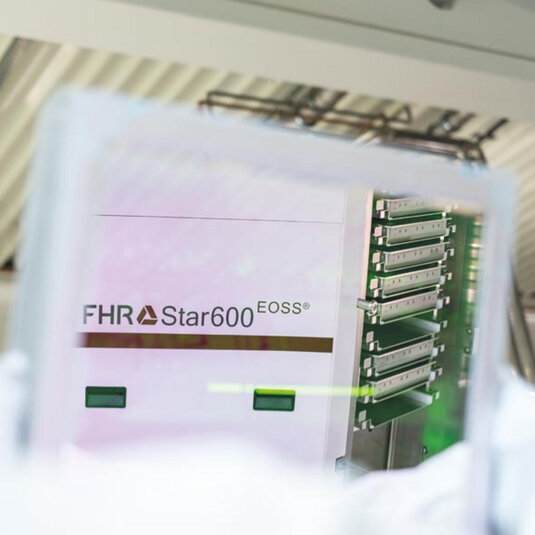
The FHR.Star.500-EOSS® is a further development of the Enhanced Optical Sputtering System (EOSS®) developed jointly with the Fraunhofer Institute for Surface Engineering and Thin Films. It is the most advanced product currently available on the market for the production of interference-optical filters.
SPECIAL FEATURES OF FHR.STAR.500-EOSS®
- Outstanding reproducibility
- Highest level of particle reduction through sputter-up process
- Optimal layer growth through bipolar controlled double sources
- Highest material utilization and longest target service life through the use of tubular cathodes
- Best layer quality through broadband monitoring and in-situ error compensation using MOCCA+®
- A design uncompromisingly geared towards production processes